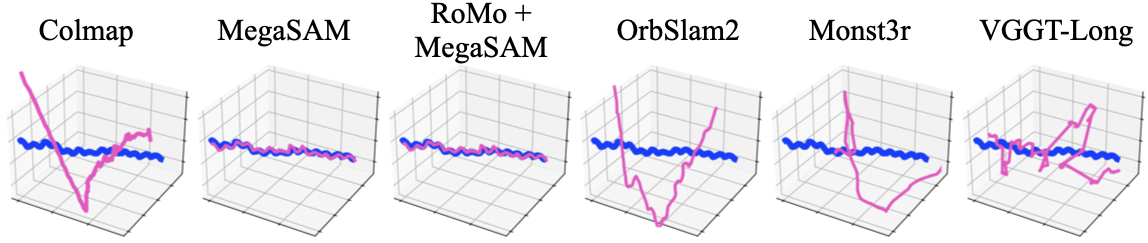
camera comparison. GT: —, Estimate: —
Input Video

camera comparison. GT: —, Estimate: —
Input Video

camera comparison. GT: —, Estimate: —
Input Video

camera comparison. GT: —, Estimate: —
Input Video

camera comparison. GT: —, Estimate: —
Input Video

camera comparison. GT: —, Estimate: —
Input Video

camera comparison. GT: —, Estimate: —
Input Video

camera comparison. GT: —, Estimate: —
Input Video
Challenge Categorization
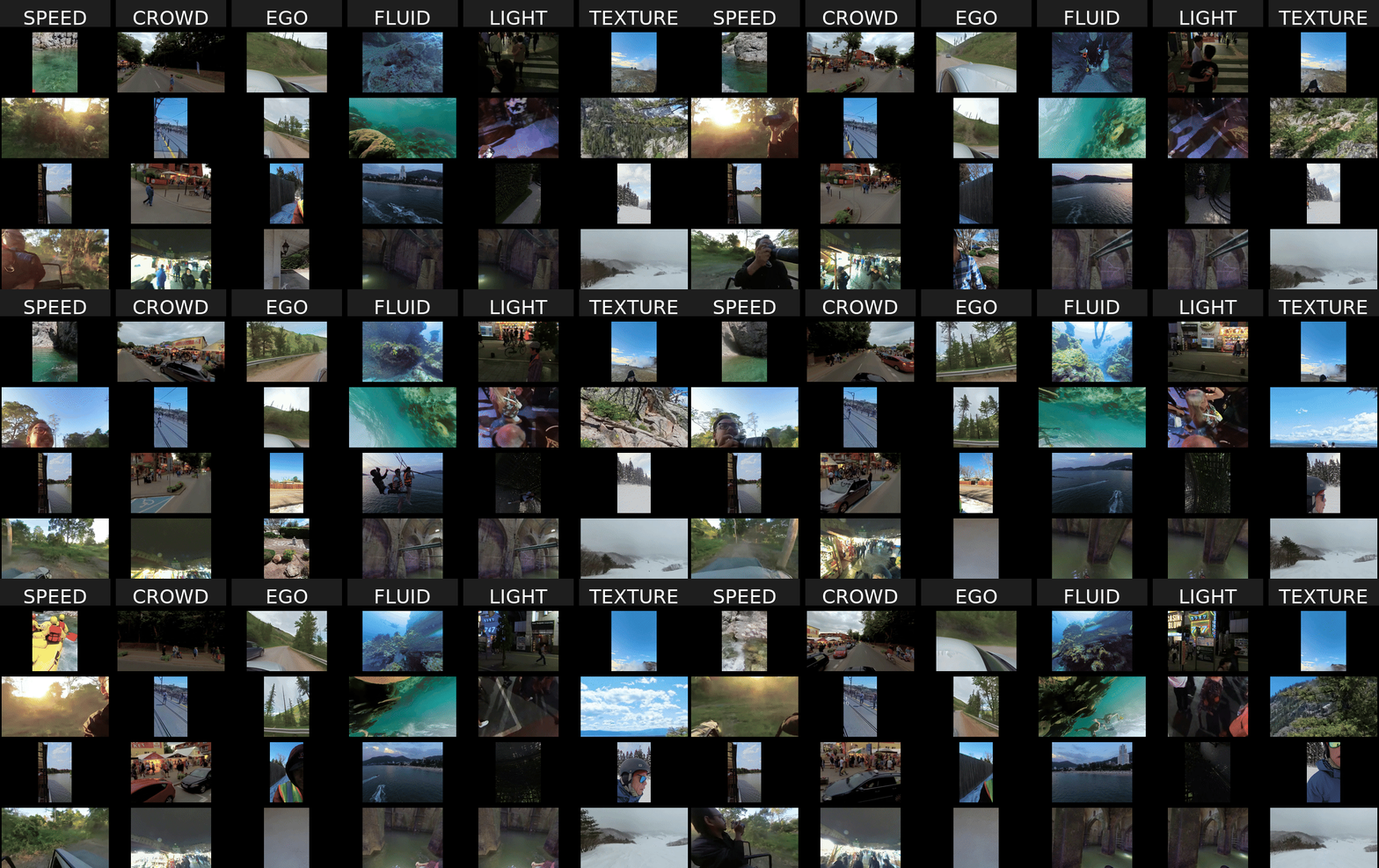
Each clip manifests a range of challenges in ORBIT. We provide sub-category evaluations on 6 of the challenges, namely High Speed, Low Texture, Low light, Presence of Crowd --Independent of camera moving Objects--, Presence of Egocentric Parallel to camera moving Objects --Ego--, and presence of Fluids. Please note that sub categories have overlap and checkout the paper for more details.
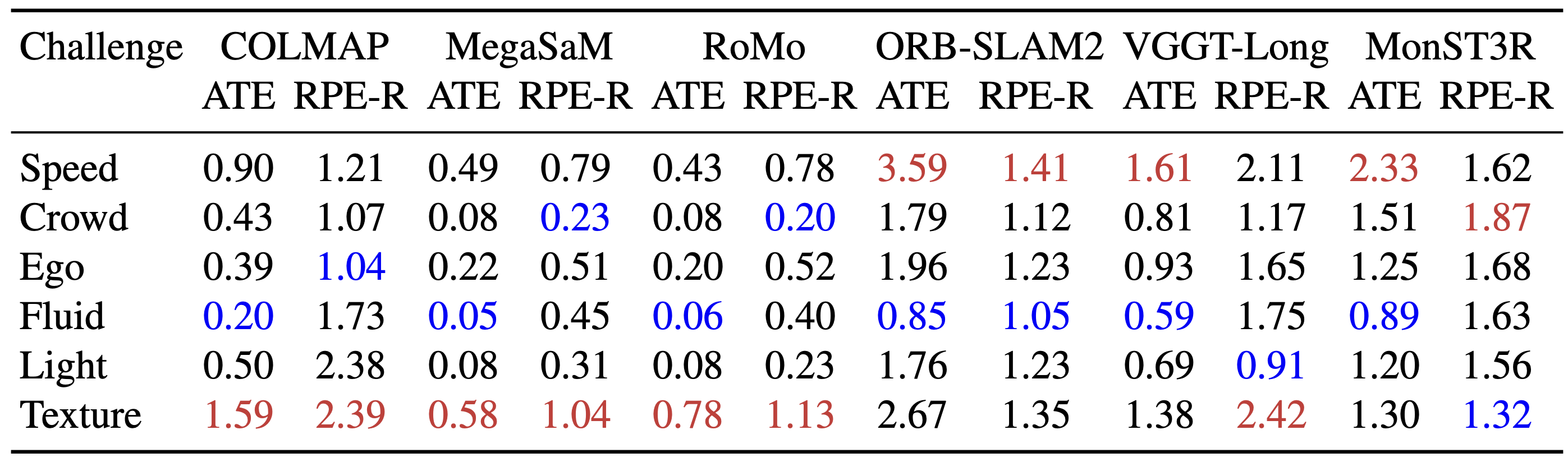
We report the ATE and RPE-R for each method on each subcategory. Based on the results, the most challenging categories are the lack of texture, affecting MegaSaM and COLMAP significantly and high speed for other methods. In the table below the red indicates the hardest challenge for each method and blue indicates the easiest challenge. We observe that MegaSaM improves significantly on the crowd challenge in compare to Colmap for example. Overall, the following table shows that ORBIT exposes a diverse set of challenges and is a valuable tool for analyzing the current state-of-the-art by highlighting their failure modes.
Previous Publication
A smaller version of ORBIT was published at CVPR 2026. You can find the CVPR paper here.
BibTeX
If you use our dataset or benchmark, please cite our paper:
@article{sabour2026orbit,
  title={ORBIT++: Benchmarking SfM in the Wild with 360$^{\circ}$ Video},
  author={Sabour, Sara and Jin, Linyi and Tucker, Richard and Hertz, Amir and Brubaker, Marcus and Saxena, Saurabh and Hur, Junhwa and Tagliasacchi, Andrea and Sun, Deqing and Fleet, David J. and Szeliski, Richard and Snavely, Noah},
  journal={arXiv preprint arXiv:2608.22039},
  year={2026}
}